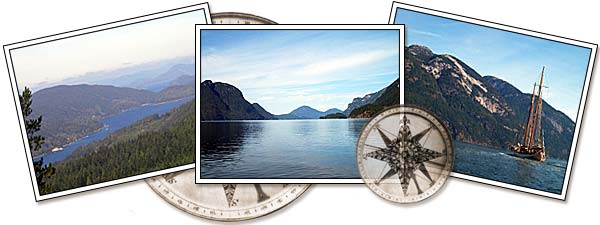
Watch a slide show and tour Lund & Desolation Sound
History
Lund is a quiet village about 17 miles north of Powell River, and the physical
ending (or, as argued by locals, the "starting") point of Highway 101,
which stretches to Chile, South America. The Historic Lund Hotel symbolizes the
heart of Lund, and to marine traffic it is the symbolic gateway to beautiful
Desolation Sound Marine Park.
The area that is now Lund has been known to the Coast Salish peoples for thousands
of years was a village site of the Sliammon people. The
village of Klah ah men was home to dozens of families and a desirable location as
it was accessible by land and sea so approaching visitors could be detected from
afar. Further, both I hohs (Savary Island) and Tohk natch (Okeover Inlet),
plentiful in shellfish, salmon and land mammals, were only short paddles away.
Fresh water was ample as were Cedar trees, the main material source in the production
of tools, shelter, clothing and more. Ceremonies, both spiritual and social in
nature, were held at Klah ah men, and included dance, song, and recreational
games that were a major part of Coast Salish culture.
On July 2, 1792 two surveying crews from Captain George Vancouver’s
ships ‘Chatham’ and ‘Discovery’ came in contact with
the Sliammon Nation for the first time. By 1876 the Canadian government had instituted
the Federal Indian Act, which established a system of reservations to which Coast
Salish peoples were relocated. Into the 1900’s these lands were surveyed
and sold, while aboriginal peoples, who were not entitled to purchase their traditional
lands or enjoy the free land grants offered by the Government to immigrating
settlers, were relocated to reservations.
In 1889, Fred & Charlie Thulin (photo Fred Thulin) arrived from Sweden, looking for a better
life in the new "land of opportunity". The brothers first set eyes
upon the area that would later become Lund while sailing by on the side-wheeler
tugboat Mermaid on their way to find employment logging in Pendrell Sound. Shortly
thereafter Fred and Charlie settled in the area they named Lund, after the University
town of the same name in their native Sweden, immediately building a wharf, logging
the bay, piping in water and converting suitable land on the settlement to farm
land.
In 1892, a post office was established, one of only two north of Vancouver
at the time. A general store was constructed and shortly thereafter the first
passenger and mail boat began making regular stops at Lund, tying it to the world.
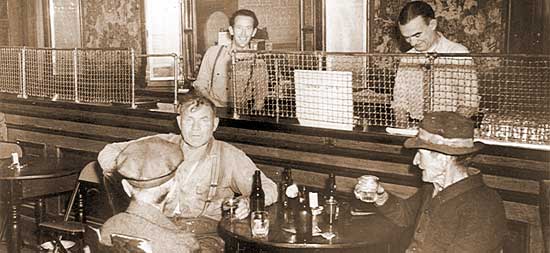
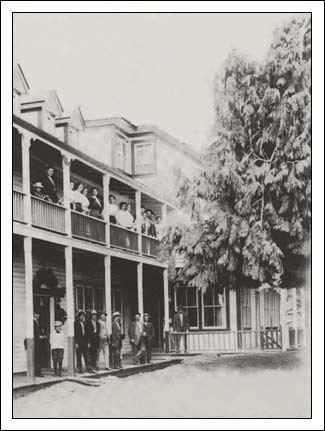
By 1895, the brothers had built Lund’s first hotel (photo), which held both the
first hotel license and the first liquor license to be issued north of Vancouver.
A bottle of the best scotch was available for $1.50 and the basement of the hotel
housed a jail cell, primarily used to “accommodate” any drunken rowdies
patronizing the hotel. By 1905 the Thulins had purchased the first donkey engine
seen up the coast, built their first steamboat, "City of Lund", and
expanded their chain of stores to Sliammon Village and to where present day Townsite
is. As coastal traffic continued to increase, in 1905 the Thulins began construction
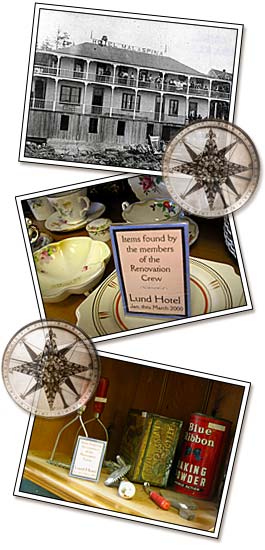
of a second hotel, The Malaspina, which in 1918 was renamed the Lund Hotel after
the original building was destroyed by fire.
In recent years the Lund Hotel became sadly neglected, finally closing its
doors in 1998. However, in November 1999 the Sliammon First Nation and businessman
David Formosa purchased the property and commenced extensive renovations, reopening
the doors in the spring of 2000. Although further improvements and expansion
are planned, the Hotel currently boasts 27 well-appointed guest rooms and the
new pub and restaurant feature un-obscured ocean views as well as spectacular
menus. During the warmer months, guests may dine on the spacious waterfront decks,
savouring the ocean breeze and the bustling activity of Lund Harbour. Historic
photos grace the walls of the entire hotel, telling the story of the Hotel and
Lund as only those immortalized by the camera could truly tell it. |
|